The equity questions behind Los Angeles’s supercommuters
By JOEY WALDINGER
A software developer commuting by train from Delaware to New York City. A Swedish nurse flying to the United States for 10-day work stints. Stories about such “supercommuters” — people who travel extra long distances for work — have grabbed headlines in recent years. Though the number of supercommuters dwindled during the pandemic, they have started to tick back up.
In Los Angeles, new research from UCLA explores supercommuters (workers who travel more than 50 miles or 90 minutes one way), who they are and the issues that come with their long journeys. The research team, led by Evelyn Blumenberg, professor and director of the Lewis Center, finds that while supercommuters comprise a small share of the region’s workers, their growing numbers — and stark differences by income and demographics — raise important questions for policy and equity.
Who are L.A.’s supercommuters?
In the Los Angeles region, about 4.5% of workers travel more than 90 minutes one way to get to work. On the whole, supercommuters tend to be higher income, male, and Black. Supercommuting is more common among transit commuters than commuters who use other modes.
Among public transit supercommuters, income divides the experience. Higher-income supercommuters are more likely to use commuter rail, while lower-income supercommuters are more likely to commute by bus — often on slower routes and with multiple transfers. For this group, long commutes refer more to duration than distance.
Where are they going? And why?
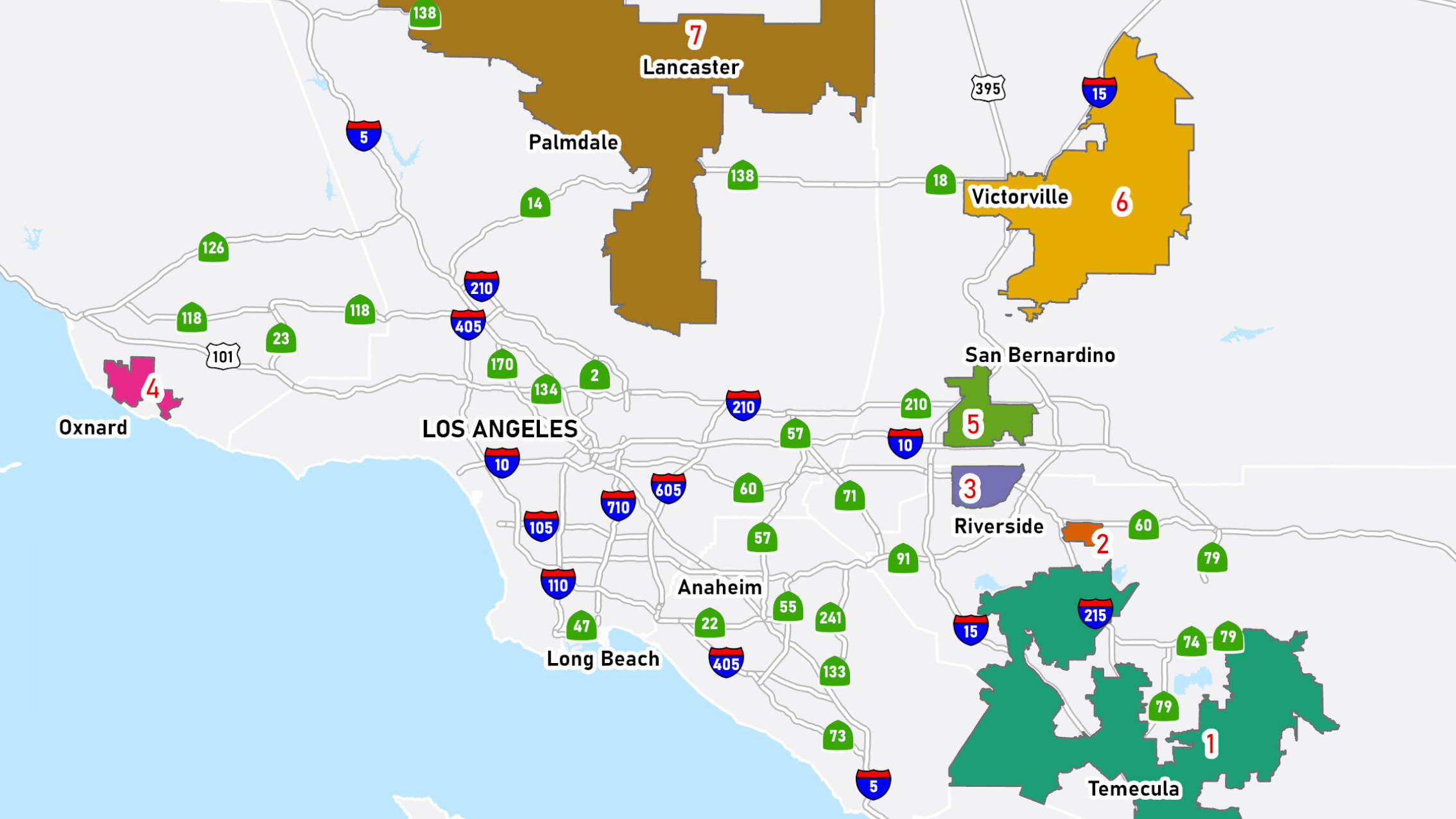
Supercommuters travel from and to all corners of the L.A. Region; however, there are some hotspots. Out of roughly 700,000 commuters who travel more than 50 miles one way to work, 25% live in one of seven “residential hotspots” across the region, with the two largest concentrations in Lancaster-Palmdale (Los Angeles County) and Perris-Lake Elsinore-Temecula (Riverside County). Most supercommuters in these residential hotspots travel to jobs located outside of major regional job centers. However, supercommuters in these hotspots are more likely to work in job centers than non-supercommuters, with Downtown Los Angeles and the Wilshire Corridor the most frequent destination.
Such long commutes can strain workers’ wallets and personal lives, so why do so many make these trips? There are several possible explanations:
- For some remote or hybrid workers, the cost of an occasional long commute might be equal or less than that of a shorter, five-day-a week commute.
- For some households, a long commute might balance a partner’s or spouse’s trip in the opposite direction.
- Some households trade long commutes for a chance at homeownership. Housing costs are much higher in major job centers than in any of the seven residential hotspots.
Policy implications
The growing number of supercommuters raises concerns about impacts on the environment, traffic congestion, and equity. Low-income supercommuters often pay the highest price, with longer travel times and higher housing and transportation cost burdens.
The research team calls for policies to offset the costs of car ownership and access (including expanding subsidies for clean-energy vehicles), enhance public transit service in dense urban neighborhoods, increase assistance to low-income, first-time homebuyers, and expand efforts to entitle more multi-family housing.
Related Material
Student fellow Alejandra Rios Gutiérrez MURP ‘24, who was recognized by APA Los Angeles for her capstone project, studied the toll of extreme commuting on lower-income communities in the San Fernando Valley.
Featured image:A map of the Los Angeles region showing freeways and color coded neighborhoods/areas as residential hotspots.