Encouraging diverse missing-middle housing near transit
superadmin2026-01-12T07:04:42-07:00This brief explores why and how jurisdictions in the Los Angeles region should zone for more diverse-types of lowrise housing, especially near transit.
This brief explores why and how jurisdictions in the Los Angeles region should zone for more diverse-types of lowrise housing, especially near transit.
This research brief focuses on Los Angeles and the San Francisco Bay Area to examine the relationship between commercial gentrification and fixed rail transit, transit ridership and traffic crashes.
In recent years, the state legislature has passed bills seeking to reform California's Housing Element Law. This brief highlights a sometimes misunderstood feature of the law's core planning tool: the RHNA process.
The purpose of this appendix is to help readers further explore similarities and differences in seven station areas ( Van Nuys, Fillmore, Wilshire/Vermont, Culver City, Leimert Park, Compton, and Paramount/Rosecrans) and to be inspired to consider how different features shape neighborhoods around rail stations throughout Los Angeles County.
This article responds to other commentaries and responses to It’s "Time to End Single-Family Zoning."
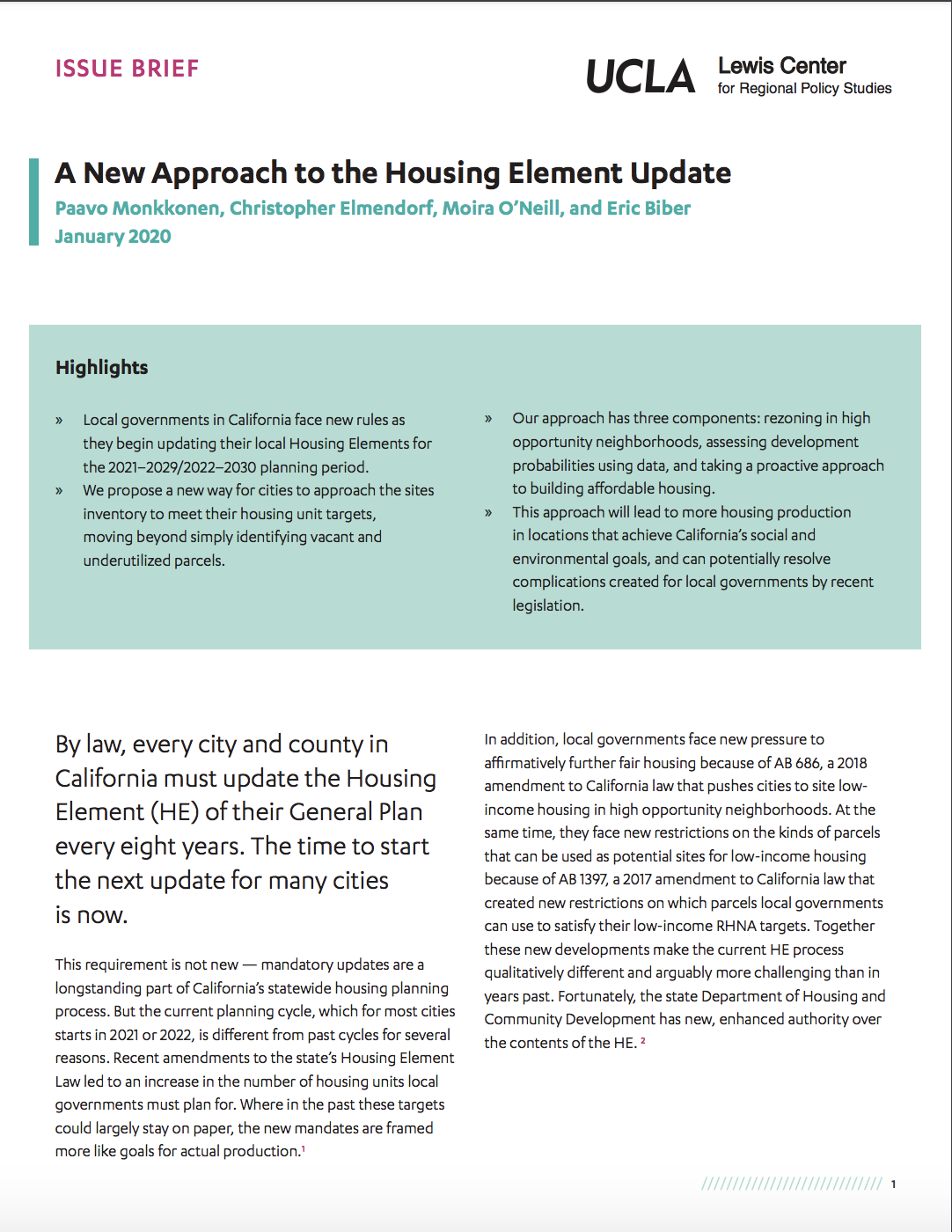
Local governments face new rules as they begin updating their local Housing Elements for the 2021-29/2022-30 planning period. This brief proposes a new way for cities to approach the sites inventory to meet their housing targets, moving beyond simply identifying vacant and underutilized parcels.
Building new housing appears to be part of the housing crisis solution. However, this brief finds that opposition to development is high due to fear of personal losses and resentment of developer gains.
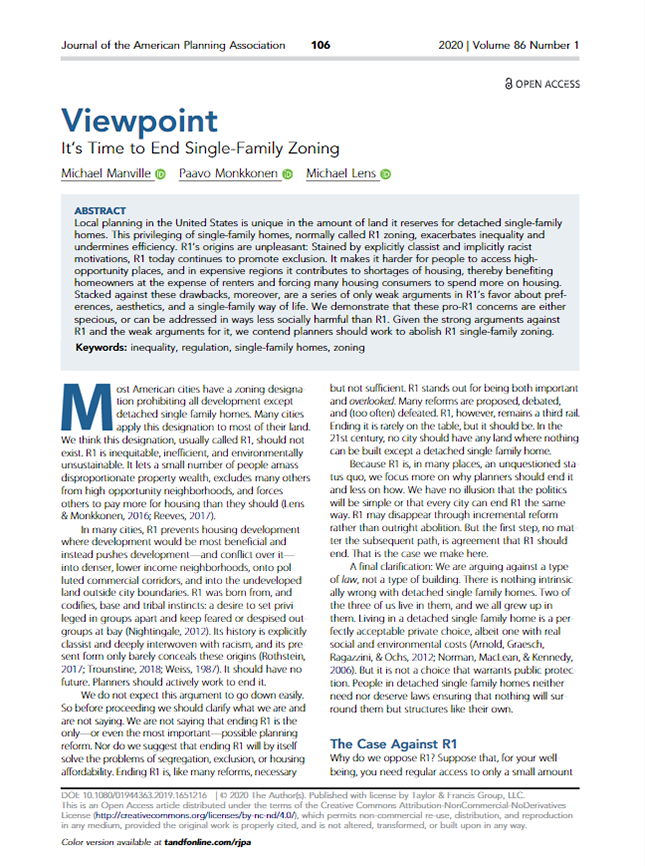
In this Viewpoints, the authors write how R1 zoning in the United States promotes exclusion and exacerbates inequality, benefiting homeowners at the expense of renters and limiting access to high-opportunity places. They argue that these negative impacts outweigh weak arguments for R1 and that planners should work to abolish it.
This summary brief is a preview of a full-length version that includes details about who builds each affordable housing category, who pays, how rents are set and can change over time, and many other policy considerations.
The San Francisco Bay Area's housing target fails to account for the fact that the region leads the nation in super-commuters, many of whom work in the Bay Area but have been driven to live outside of it.