By Transit, By-Right: Impacts of Housing Development Approval Processes on Transit-Supportive Density

2026-01-07T07:00:48-07:00

This brief studies the relationship between transit ridership and the housing development process. Even if new multifamily housing is allowed on a site, a complicated, lengthy or unpredictable process could still discourage its production and thus, transit ridership.

By Transit, By-Right: Impacts of Housing Development Approval Processes on Transit-Supportive Density2026-01-07T07:00:48-07:00

A Review of California’s Process for Determining, and Accommodating Regional Housing Needs

2026-01-07T07:00:48-07:00

This background paper is meant to help the California State Auditor and legislators better understand the limitations of the RHNA process and areas for improvement.

A Review of California’s Process for Determining, and Accommodating Regional Housing Needs2026-01-07T07:00:48-07:00

Regional Housing Needs Assessment Cover Letter

2026-01-07T07:00:52-07:00

This review and cover letter was written to provide background and suggestions for Auditors Tilden and Lozano to consider in relation to the audit commissioned by the Joint Legislative Audit Committee at the request of Members Glazer, Newman, Bauer-Kahan, Portantino, Muratsuchi, Stern, and Bates.

Regional Housing Needs Assessment Cover Letter2026-01-07T07:00:52-07:00

Housing And Community Development In California: An In-Depth Analysis of the Facts, Origins and Trends of Housing and Community Development in California

2026-01-07T07:00:47-07:00

This report provides detailed analysis on where California's housing has been, where it’s at and where it’s headed when it comes to possible scenarios and policy alternatives for the future.

Housing And Community Development In California: An In-Depth Analysis of the Facts, Origins and Trends of Housing and Community Development in California2026-01-07T07:00:47-07:00

The Future of Housing and Community Development: A California 100 Report on Policies and Future Scenarios

2026-01-07T07:00:47-07:00

This report examines where California's housing has been, where it’s at and where it’s headed when it comes to possible scenarios and policy alternatives for the future.

The Future of Housing and Community Development: A California 100 Report on Policies and Future Scenarios2026-01-07T07:00:47-07:00

Building Up the “Zoning Buffer”: Using Broad Upzones to Increase Housing Capacity Without Increasing Land Values

2026-01-07T07:00:47-07:00

In this paper I introduce the concept of the “zoning buffer” — the gap between the existing housing stock and the maximum number of homes allowed by current zoning — and describe how it affects land values and ultimately the production and affordability of housing.

Building Up the “Zoning Buffer”: Using Broad Upzones to Increase Housing Capacity Without Increasing Land Values2026-01-07T07:00:47-07:00

Who Lives in Vehicles and Why? Understanding Vehicular Homelessness in Los Angeles

2026-01-07T07:00:45-07:00

What are the unique characteristics of people living in vehicles in Los Angeles? These findings will help effectively target policies and services, such as safe parking programs that can offer temporary relief and interventions necessary to transition into permanent housing.

Who Lives in Vehicles and Why? Understanding Vehicular Homelessness in Los Angeles2026-01-07T07:00:45-07:00

Geographic and Regulatory Impacts on Vehicular Homelessness in Los Angeles

2026-01-07T07:00:45-07:00

Almost half of Los Angeles's unsheltered population live in their vehicles. Over the years, local complaints have amplified the proliferation of vehicular-dwelling criminalization ordinances — making it difficult for people to locate safe places to park, elevating fears of being towed, ticketed, or interacting with the police.

Geographic and Regulatory Impacts on Vehicular Homelessness in Los Angeles2026-01-07T07:00:45-07:00

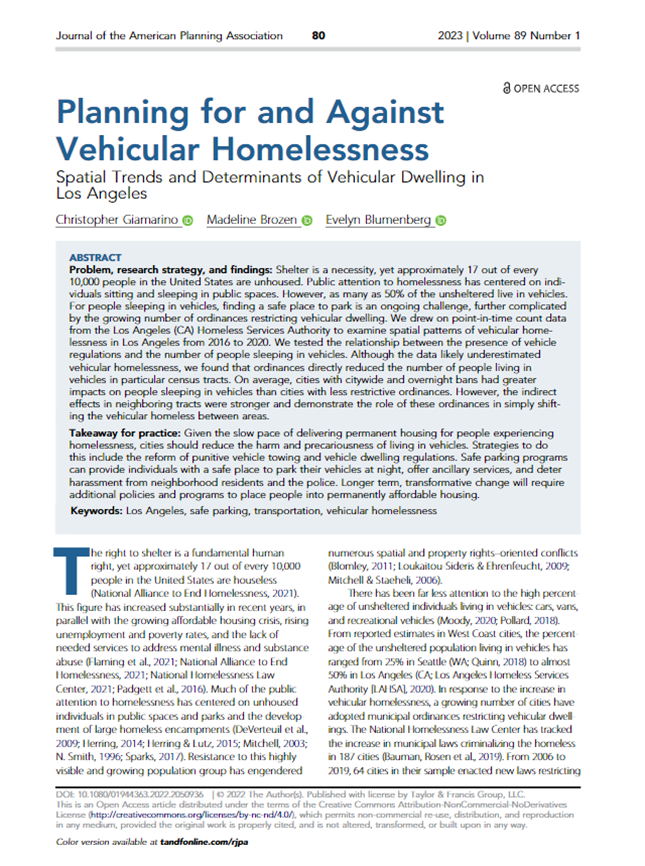
Planning for and Against Vehicular Homelessness: Spatial Trends and Determinants of Vehicular Dwelling in Los Angeles

2026-01-07T07:00:46-07:00

Discover the prevalence of vehicular homelessness in Los Angeles County and the impact of regulations on people living in their vehicles. Findings suggest cities should reduce harm and precariousness through reforming punitive regulations and implementing safe parking programs while pursuing permanent affordable housing solutions.

Planning for and Against Vehicular Homelessness: Spatial Trends and Determinants of Vehicular Dwelling in Los Angeles2026-01-07T07:00:46-07:00

A Primer on California’s “Builder’s Remedy” for Housing-Element Noncompliance

2026-01-07T07:00:46-07:00

Since 1990, California allows developers of affordable housing projects to bypass zoning codes and general plans of cities out of compliance with the Housing Element Law. Why aren't there more builder's remedy projects?

A Primer on California’s “Builder’s Remedy” for Housing-Element Noncompliance2026-01-07T07:00:46-07:00
Go to Top