

2025 | Housing Initiative
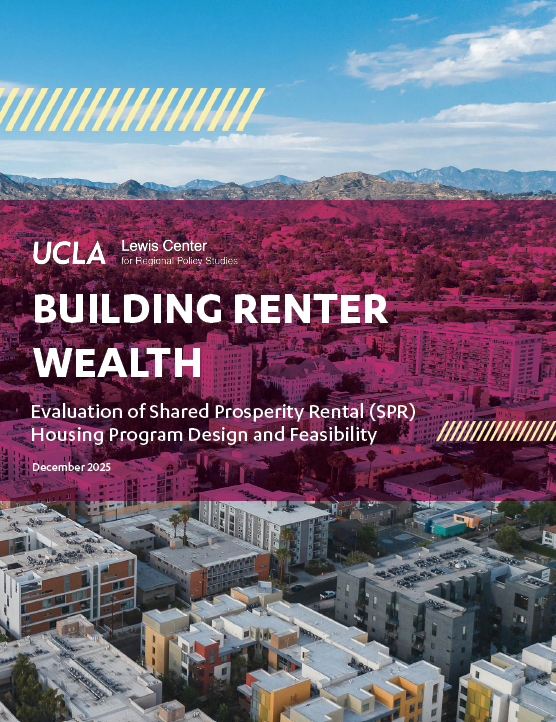
Building Renter Wealth: An Evaluation of Shared Prosperity Rental (SPR) Housing Program Design and Feasibility
Project Description
Link to Full Report (168 pages)
Link to Executive Summary (18 pages)
To learn more about SPR Housing, including potential opportunities to fund follow-up evaluations or program implementation, please contact Shane Phillips at shanephillips@ucla.edu.
Homeownership is an expensive, risky investment, but also a major source of wealth and security for many households. Renting offers flexibility and financial accessibility, but lacks the wealth-building opportunities of ownership. Are other models possible? To help answer this question, we evaluated the feasibility of "shared prosperity rental housing” (SPR), an innovative housing model seeking to combine benefits of homeownership and renting while mitigating their drawbacks. With support from MapCraft, Inc., this project evaluates the financial feasibility and tenant benefits associated with different models, identifies major barriers to adoption, and suggests policy reforms and financial instruments that could help it succeed.
We find that SPR housing could be viable in several California markets if backed by low interest, high leverage loans and a supportive regulatory environment, potentially attracting the privately funded developers and investors needed for rapid program expansion. Most importantly, we find that tenants could build substantial wealth without facing the same risks or barriers to entry as homeowners.
Key Takeaways
Study Purpose and Disclaimers: This study set out to explore the potential feasibility of a novel housing model, one that we at the UCLA Lewis Center call shared prosperity rental (SPR) housing. The Lewis Center engaged real estate analytics firm MapCraft Inc. to build a real estate financial pro forma model that could represent the financial performance of various SPR approaches. This pro forma modeling exercise was intended to illustrate how an SPR housing program could be designed to build tenant wealth, and the results should be understood as highly speculative. This report presents the Lewis Center’s interpretation of this study’s results, which rest on the generous contributions of reviewers and MapCraft. The views and opinions expressed in this report are those of the author and do not necessarily reflect those of the contributors, who are in no way responsible for the final publication or any errors therein.
1. Homeownership is the primary source of wealth for millions of American households, but rising prices have put this wealth creation option out of reach for many potential buyers, and it’s undesirable for many more. A new wealth-building model — one that doesn’t rely solely on homeownership — is needed.
Homeownership has many benefits. As prices rise, however, fewer people are able to become homeowners, potentially widening the disparity between owners and renters. And homeownership doesn’t always deliver on its promises: Returns on investment depend heavily on purchase and sale timing, interest rates and other macroeconomic factors, location, and even race and ethnicity, and ownership can worsen labor outcomes by reducing household mobility.
We need better alternatives to ownership than what’s available today — alternatives that provide wealth-building opportunities without the financial risk, high barriers to entry, and low flexibility of owning a home.
2. The shared prosperity rental model can help tenants build wealth simply by paying their rent. Using pro forma analysis to evaluate the model for different housing types and submarkets, we find that SPR pays back more than half of rents in many scenarios — often on relatively fast timelines.
In the SPR model, tenants build wealth by paying rent and accumulating “rental rewards,” which then pay annual dividends based on a building’s financial performance. From the tenants’ perspectives, SPR is indistinguishable from renting a traditional apartment in most other respects.
Where SPR housing is financially feasible, we find that it can help tenants build significant wealth. In the Oakland development scenario explored in detail in Chapter 5, a tenant living in their apartment for five years earns back a total of 25–45% of their rent through annual rental reward dividends, and a 10-year tenant earns back 37–89% of rent. For longer tenancies, returns can add up to hundreds of thousands of dollars, helping renters offset future housing costs, buy a home, support their education or start a business.
3. SPR can earn project sponsors competitive profits without direct subsidies, allowing for rapid expansion to benefit large numbers of households.
Our results show that shared prosperity rental housing — specifically the Ideal Loan Product SPR model described in Chapter 4 — can earn project sponsors competitive returns on investment. Development or acquisition of SPR housing is feasible in three of the four housing markets studied in this report: Oakland, Los Angeles, and Sacramento. Neither the traditional nor the SPR business models are feasible in San José. Our benchmark for feasibility is a target 14% internal rate of return and meeting or exceeding the IRR of traditional rental housing operators in the same market (see Chapter 5). By reducing the role of equity investors, the SPR model may also reduce downside risk for project sponsors compared to traditional rental housing investment.
4. Low-interest, high loan-to-value financing is an attractive tool for supporting shared prosperity rental housing, and has proven successful in other contexts in the U.S.
Our preferred SPR funding model uses low-interest, high loan-to-value (up to 90% LTV) permanent loans to make tenant profit-sharing financially feasible. This approach draws inspiration from longstanding mortgage products like the FHA loan and VA loan, which benefit homeowners, while also recognizing the unrealized potential of products like HUD Section 221(d)(4) multifamily loans. We discuss these loan products in more detail at the end of Chapter 4.
For each of these financial products, the government bears some lending risk for socially beneficial ends. In this report we show that this same approach can be used to help renters build substantial wealth without (or before) becoming homeowners.
5. Wealth benefits are highly sensitive to program design — especially decisions about incentivizing longer-term tenants and rental reward expiration.
How tenants accumulate rental rewards and when they expire (i.e., cease paying annual dividends) has a powerful effect on tenant financial benefits. Shorter expiration periods reduce the number of outstanding rental rewards in a given year, thereby increasing their average value. For example, in the Oakland development scenario, a 10-year tenant earns back 45.8% of rent payments (inflation-adjusted) over the lifetime of their rental rewards when assuming the average reward expires after 20 years. Assuming an average expiration period of 10 years nearly doubles the tenant’s total returns, to 88.6% of rent.
Importantly, changing reward accumulation and expiration policies does not change the total amount of funds allocated to tenants — it reallocates funds among tenants. We explore program design details and alternatives in Chapter 6 and Appendix B.
6. SPR housing could level the playing field between renters and homeowners, but it is a new and largely untested concept. Its success depends on long-term commitment and significant policy changes.
Implementing shared prosperity rental housing will require forceful advocacy and proactive policymaking. Supporters must make the case for a supportive financing framework, as was done for FHA and VA loans in the past, and they must overcome various legal barriers. State and federal agencies must implement the reforms. Industry professionals must be convinced to participate — that the risk profile, financial performance, reputational benefits, and other considerations favor building and operating SPR housing. See Chapter 6 for a longer discussion of potential obstacles to success.
Pilot programs, already being tested in different forms by organizations like Enterprise Community Partners and the Colorado Housing Accelerator Initiative Tenant Equity Vehicle (see Chapter 3), will play a crucial part in demonstrating the promise of SPR housing for tenants and project sponsors alike.
7. The SPR model can be tailored to a variety of different markets, building and production types, ownership models, and tenant profiles.
We consider alternatives to the for-profit, privately operated multifamily SPR model in Chapter 6. Specifically, we explore a nonprofit cooperative housing model, a public sector pension-like model, and a single-family build-to-rent model. While not a comprehensive list of options, these examples are intended to encourage policymakers, advocates, and industry professionals to think creatively about how the SPR model could be adapted to different political, social, legal, and economic contexts. This includes adapting the program to serve different tenant populations, whether by age, income, wealth, or other characteristics. Some program alternatives will require different funding approaches, such as public subsidies, to be feasible.
Publications
Report • 2025
Building Renter Wealth: An Evaluation of Shared Prosperity Rental (SPR) Housing Program Design and Feasibility
Status
Complete
Funding Source
Chan Zuckerberg Initiative
PI Contact

Shane Phillips
Housing Initiative Project Manager